How Do You Know That a Chemical Reaction Has Occurred
Table of Content
Types of Chemical Reactions Table Different Types of Chemical Reactions Example Problem
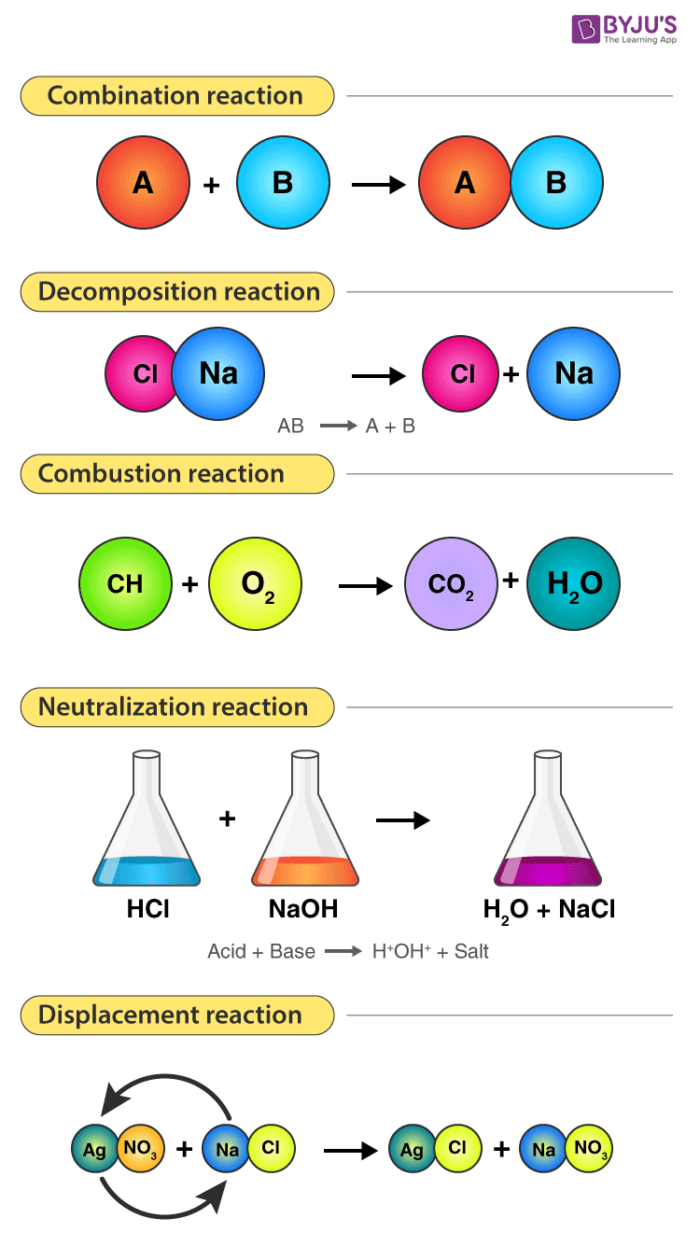
Different Types of Chemical Reactions – Combination, Decomposition, Combustion, Neutralization & Displacement Reactions
During a chemical reaction, the substances that react are known as reactants whereas the substances that are formed during a chemic reaction are known as products . Half-dozen common types of chemical reactions are discussed below.
| Types of Chemic Reactions | Explanation | General Reaction |
| Combination reaction | Two or more compounds combine to form one compound. | A + B → AB |
| Decomposition reaction | The reverse of a combination reaction – a complex molecule breaks down to make simpler ones. | AB → A + B |
| Atmospheric precipitation reaction | Two solutions of soluble salts are mixed resulting in an insoluble solid (precipitate) forming. | A + Soluble salt B → Precipitate + soluble salt C |
| Neutralization reaction | An acid and a base of operations react with each other. Generally, the product of this reaction is a table salt and water. | Acid + Base → Table salt + Water |
| Combustion reaction | Oxygen combines with a compound to form carbon dioxide and water. These reactions are exothermic, meaning they requite off heat. | A + O2 → HtwoO + COii |
| Displacement reaction | One element takes place with some other element in the compound. | A + BC → AC + B |
Recommended Videos
Types Of Organic Reactions

Types of Chemical Reactions

Unlike Types of Chemical Reactions
The 5 primary types of chemical reactions are:
- Combination reaction
- Decomposition reaction
- Displacement reaction
- Double Displacement reaction
- Atmospheric precipitation Reaction
i. Combination Reaction
- A reaction in which 2 or more reactants combine to form a single product is known as a combination reaction.
- It takes the form of X + Y → XY
- Combination reaction is besides known as a synthesis reaction.
- Example of combination reaction: 2Na + Cl2 → 2NaCl
ii. Decomposition Reaction
- A reaction in which a single compound breaks into 2 or more simpler compounds is known as a decomposition reaction.
- It takes the form of XY → X + Y
- A decomposition reaction is just the opposite of combination reaction.
- Example of a decomposition reaction: CaCO3 → CaO + CO2
- The reaction in which a chemical compound decomposes due to heating is known as a thermal decomposition reaction.
3. Displacement Reaction
- A chemical reaction in which a more reactive element displaces a less reactive chemical element from its aqueous salt solution.
- Information technology takes the class X + YZ → XZ + Y
- It is as well chosen a substitution reaction
- Example of displacement reaction: Zn + CuSO4 → ZnSO4 + Cu
4. Double Deportation Reaction
- A chemical reaction in which ions gets exchanged between two reactants which grade a new chemical compound is called a double displacement reaction.
- It takes the form of XY + ZA → XZ + YA
- It is also chosen a metathesis reaction
- Example of double displacement reaction:
\(~~~~~~~~~~~\)BaClii + NaiiSO4 → BaSOiv + 2NaCl
5. Precipitation Reaction
- A chemical reaction that involves the formation of an insoluble product (precipitate; solid) is called Precipitation reaction.
- The reactants are soluble, but the product formed would exist insoluble and separates out as a solid.
- The chemic equation by which a chemic alter is described is adequate for reaction in solutions, but for reactions of ionic compounds in aqueous solution (water), the typical molecular equation has unlike representations.
- A molecular equation may point formulas of reactants and products that are not present and eliminate completely the formulas of the ions that are the real reactants and products.
- If the substance in the molecular equation that is actually present as dissociated ions are written in the course of their ions, the event is an ionic equation.
A atmospheric precipitation reaction occurs when a solution, originally containing dissolved species, produces a solid, which generally is denser and falls to the bottom of the reaction vessel.
The most common atmospheric precipitation reactions occurring in aqueous solution involve the formation of an insoluble ionic compound when two solutions containing soluble compounds are mixed. Consider what happens when an aqueous solution of NaCl is added to an aqueous solution of AgNO3. The first solution contains hydrated Na+ and Cl− ions and the 2nd solution, Ag+, and NO3 − ions.
NaCl(s) → Na+(aq) + Cl−(aq)
AgNO3(southward) → Ag+(aq) + NOthree −(aq)
When mixed, a double deportation reaction takes identify, forming the soluble compound NaNO3 and the insoluble chemical compound AgCl. In the reaction vessel, the Ag+ and Cl− ions combine, and a white solid precipitated from the solution. Every bit the solid precipitates, the Na+ and NOthree − ions remain in solution.
The overall double displacement reaction is represented by the following balanced equation:
NaCl(aq) + AgNO3(aq) → AgCl(due south) + NaNOiii(aq)
Example Problem
- When aqueous solutions of Lead(NOthree)2 and KI are mixed, does a precipitate course?
- Write a balanced equation for the precipitation reaction that occurs when aqueous solutions of copper(2) iodide and potassium hydroxide are combined.
Solution:
Yous are asked to predict whether a precipitate will course during a chemic reaction and to write a balanced equation for a precipitation reaction.
Y'all are given the identity of two reactants.
ane. Yep, a solid precipitate, PbItwo, forms when these solutions are mixed:
Atomic number 82(NO3)2(aq) + KI(aq)→ PbI2(south) + 2KNO3(aq)
ii. The two products of the reaction are insoluble copper (II) hydroxide and soluble potassium iodide.
CuItwo(aq) + 2 KOH(aq)→ Cu(OH)2(s) + two KI(aq)
Frequently Asked Questions – FAQs
How do you identify a chemical reaction?
A chemical reaction is typically followed by physical signs that are readily detected, such as oestrus and light emission, precipitate formation, gas development, or a change of appearance.
How do you lot identify physical and chemical changes?
The shape or form of the matter varies through a physical transition, but the sort of matter in the material does not. In a chemical shift, however, the type of matter shifts and at least i new material with new properties is created. At that place is no straight cut of the gap between physical and chemical transition.
Why do we write a chemical equation?
The purpose of writing a balanced chemical equation is to explain the occurring reactants (starting material) and products (end results). The ratios in which they answer so that you can mensurate the amount of reactants yous demand and the amount of goods yous tin can brand.
What is chemical reaction and equation?
A chemic equation is the symbolic representation in the course of symbols and formulas of a chemical reaction in which the reactant entities on the left-hand side and the production entities on the right-hand side are given.
What is the skeleton equation?
A skeleton equation is when each product that takes part in the reaction is written with the chemical formulas describing the chemical reaction. Examples: The term equation: oxygen + methane. Dioxide with carbon + Vapour.
Read more than about types of chemic reactions. To follow more than about the types of chemic reactions, download BYJU'South – the learning app.
How Do You Know That a Chemical Reaction Has Occurred
Source: https://byjus.com/chemistry/types-of-chemical-reactions/
0 Response to "How Do You Know That a Chemical Reaction Has Occurred"
Post a Comment